

At Salop Design & Engineering, the implementation of the Theory of Constraints (TOC) in 2020 represented a fundamental shift in how we plan, schedule, and control production. Developed by Dr. Eliyahu Goldratt, TOC is a systems-based management philosophy that recognises every complex operation is limited by a small number of constraints, and that overall performance is governed not by how efficiently every process runs, but by how effectively the primary constraint is identified, protected, and exploited.
Unlike traditional efficiency-driven approaches, which often lead to excess WIP, extended lead times, and poor delivery performance, TOC focuses on maximising system throughput by subordinating non-critical resources to the pace of the constraint. Failure to manage constraints properly often results in a chaotic production environment where local efficiencies mask systemic bottlenecks, leading to erratic lead times, unbalanced resource loading, and frequent expedite requests—all of which degrade customer service and increase operating costs.
By embedding TOC principles into our operational model—through Full Kit control, visual scheduling, and finite capacity planning—SDE has achieved significant improvements in flow stability, lead-time compression, and delivery reliability. The result is a production environment that is predictable, data-driven, and synchronised with customer demand, enabling us to deliver high-performance manufacturing with confidence.
Full Kit & TOC-Controlled Production
SDE follows the TOC principle that no job is released to the shop floor until it is 100% kitted, ensuring uninterrupted production flow and minimising WIP inventory. The “Full Kit” policy confirms the availability of:
- Raw materials
- Tooling and fixtures
- Packaging and pallets
- Process capacity and operator availability
A typical presswork operation at SDE is structured for velocity:
- 3 days to Full Kit
- 3 days for manufacture
- 1 day dispatch buffer
- 7-day total lead time from kit to customer
The actual production time or batch quantity is typically less than 1 day, with the remainder of the schedule structured around readiness, flow, and delivery assurance.
Work Order Visual Priority Control
To maintain flow and protect constraint capacity, all work orders are colour-coded based on proximity to the due date:
Blue → Green → Amber → Red → Black
As the job nears its delivery deadline, the colour changes. Once a job reaches Black, it enters the dispatch buffer and is treated as a site-wide expedite priority. This visual system ensures that non-constraints never outpace the constraint, in line with Goldratt’s third focusing step: Subordinate everything else to the constraint.
Stock Accuracy & ERP Integration
Once work orders are completed, SDE operates a strict stock control and traceability process:
- Parts are moved to the Drop Off Zone
- Automatically booked into Finished Goods Stock
- Raw materials are backflushed from inventory
- The job is closed financially and administratively in the ERP system
This creates real-time traceability, inventory accuracy, and visibility for customer order tracking, all of which are essential for managing the flow through and around constraints.
Logistics Control via Salop Haulage
Our transport operations are fully integrated through our logistics partner, Salop Haulage. With a dedicated fleet of 26 vehicles, this provides:
- Real-time control over outbound deliveries
- Built-in Just-in-Time (JIT) capability
- Same-day and priority delivery options
- Advanced Shipping Notices (ASNs) sent before trucks leave site
- All collections/deliveries scheduled via a digital portal with fixed time slots
This approach aligns with TOC principles by removing downstream variability, stabilising the delivery pipeline, and supporting our exceptional On Time In Full (OTIF) performance.
Continuous Improvement Using TOC – The POOGI Loop
At Salop Design & Engineering, continuous improvement is not a one-time initiative—it’s a structured, systematic discipline. Central to this is the Process of On-Going Improvement (POOGI), a core framework of the Theory of Constraints that drives long-term operational excellence.
POOGI is built on Five Focusing Steps, each designed to identify and eliminate bottlenecks, improve flow, and maximise throughput across the entire system:
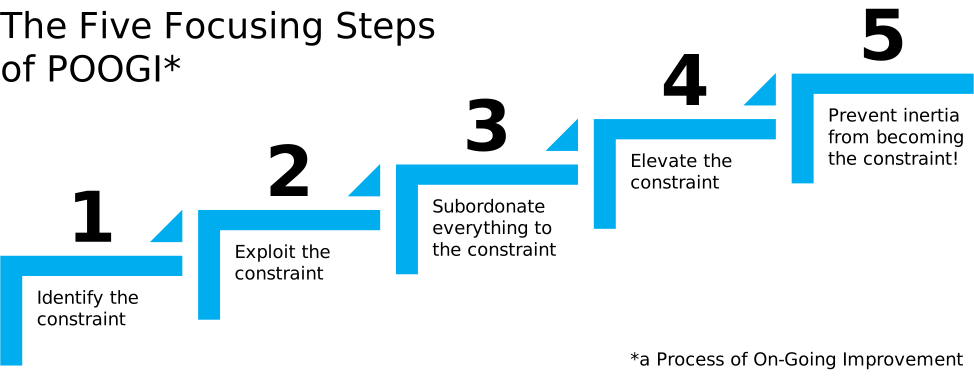
- Identify the Constraint – Pinpoint the single resource or process that limits overall output. This could be a press tool, a machining centre, or even a planning capacity issue.
- Exploit the Constraint – Maximise performance without new investment. We measure OEE (Overall Equipment Effectiveness) at the constraint, sharpen tooling, ensure staff availability, and minimise downtime through proactive maintenance and process discipline.
- Subordinate Everything Else – The entire production system is paced to the constraint. Non-bottleneck resources are prevented from overproducing, helping to eliminate excess WIP, reduce lead times, and protect flow stability.
- Elevate the Constraint – If performance is still insufficient, additional resources are applied: e.g. machine upgrades, extra shifts, reallocated tooling, or outsourcing as a strategic stopgap.
- Prevent Inertia – When constraints shift—as they inevitably do—we return to Step 1. This ensures the improvement cycle never stagnates and the system remains agile and responsive.
At SDE, constraints are not static. We conduct weekly cross-functional reviews at each major work centre to monitor flow, capacity, and load. These reviews trigger POOGI cycles when bottlenecks are detected, typically through a combination of:
- Dashboards
- Material flow visualisations
- Colour-coded work order status
- Job tracking via ERP and digital Kanban
We support the POOGI loop with a range of diagnostic and continuous improvement tools including:
- 5 Why root cause analysis
- Pareto reviews of downtime and scrap
- Faro Arma 3D laser measurement systems
- Automated CMM (Coordinate Measuring Machines)
- Real-time data capture via ERP and shopfloor terminals
SDE also applies TOC’s buffer management methodology by maintaining a visible dispatch buffer, ensuring any job entering the final 24–48 hour window is flagged for expedited handling. Jobs are colour-coded through the production lifecycle—from Blue to Black—ensuring the entire site is aligned around the most time-sensitive deliveries.
The Results
Since adopting TOC in 2020, Salop Design & Engineering has:
- Reduced average lead times by >35%
- Increased customer OTIF to >98%
- Minimized WIP inventory
- Increased visibility and scheduling control
- Embedded a culture of constraint awareness across all departments
SDE's TOC-Driven Advantage
By combining lean visual management, ERP integration, TOC-based production control, and end-to-end logistics oversight, SDE offers its customers rapid, reliable, and fully traceable supply chain performance—from raw material to finished component, every time.